Leadership Alchemy: Essential Truths for Driving Transformational Change

Leadership expert Michael Corvini’s debut book, LEADERSHIP ALCHEMY: Essential Truths for Driving Transformational Change, opens with an astute potted history of leadership ideas. Beginning with Xenophon’s Cyropaedia, a comprehensive analysis of the conquests of Cyrus the Great (published circa 370 BCE), Corvini notes that it took until the 1990s for something “new” to be added to Xenophon’s insights. The author cites “checks and balances, follower empowerment, psychological safety, and emotional intelligence” as being the most important of these evolutions in leadership thought. Otherwise, in Corvini’s opinion, Xenophon pretty much had it down right from the off.
In his introduction, Corvini asks the rhetorical question of what he could possibly be bringing to the table that is new in an obviously saturated business book market. He is refreshingly honest in his response: “The answer is that nothing will be new. In fact, this book is grounded in the belief that the greatest leadership mysteries are not novel—they are enduring.” Corvini’s aim is to simply empower readers to hone their critical thinking to spot the truths that are hiding in plain sight.
In fact, Corvini does try a new lens to focus on transformational change, using allegory and myth as a way to explore the nuances of management strategies. To do this, Corvini reproduces an illustrated version of an ancient tale: The Story of the Master Alchemist. The three key elements to the story are the alchemist’s requirement of a transmutable base metal, the combination of the Elixir of Life, and the use of the Philosopher’s Stone. It doesn’t take much of a leap in imagination to see how the author is able to transfer this tale into a flexible, insightful parable of the world of management.
Corvini urges readers to think for themselves and identify what the story might mean on an individual basis. To his credit, he eschews the didactic tone that bogs down so many similar books. Instead, he offers ideas and avenues of thought that the reader may explore if they so choose—rather than erect rigid signposts to guide the way towards pre-determined goals. It’s a gentle approach that may suit those tired of relentless, barking management-speak.
The book is well-designed and includes numerous charts and diagrams which, for a change, each serve a clear purpose in visually distilling the information under discussion (rather than cluttering up the narrative like an over-exuberant PowerPoint presentation). Corvini should also be commended for the comprehensive source notes provided for all of the material referenced in the text.
LEADERSHIP ALCHEMY: Essential Truths for Driving Transformational Change is a thought-provoking manual that offers guidance on how best to improve management and leadership skills. Though thoroughly researched and clear in its aims, Michael Corvini's book manages to guide readers with a light touch—foregrounding critical thinking and the exploration of ideas, rather than rigid goal-setting.
—Kent Lane for IndieReader
The secrets to great leadership are actually very simple, Corvini asserts early on in this intriguing debut.
Using the allegorical story of the Master Alchemist—which he credits to several different cultures across time—Corvini constructs his own practical advice for what the story’s primary elements represent in the leadership realm: base metal symbolizes people and processes that need to be refined; the elixir of life stands for Transformational Care; the Philosopher’s Stone is Transformational Challenge; gold represents people and processes meeting their highest potential; and the Master Alchemist is a leader who combines Transformational Care and Challenge to help their staff “achieve something extraordinary.”
Corvini blends those components into what he calls an alchemical leadership formula, starting with the traits that define a Master Alchemist and explaining what exactly it means to provide Transformational Care—seemingly minor acts of kindness and connection with others that can make a profound difference. That kind of care in a leadership setting can “improve organizational culture, organizational citizenship, engagement, retention, teamwork, innovation, and performance,” he writes. In the same vein, Transformational Challenge includes intense undertakings that drive change, and leaders must be willing to incorporate a wide range of tactics for these to succeed: identify clear goals and expectations, establish action plans, deliver coaching, and more.
Throughout his writing, Corvini prompts leaders to self-reflect, often through included assessments and guided journaling, and he shares several case studies to help illustrate his view of functional leadership.
The result is empowering and uplifting, and readers will find Corvini’s methods a solid approach to building authentic connections with others, inspiring a “dramatic metamorphosis” from the inside out, and learning how to prioritize both people and performance. Once a leader has mastered those techniques, Corvini asserts they will “hold the keys to unlocking latent potential within people and processes… bringing the allegorical story of the Master Alchemist to life.”
The Physics of Leadership: A Common-Sense Guide to Uncommon Success
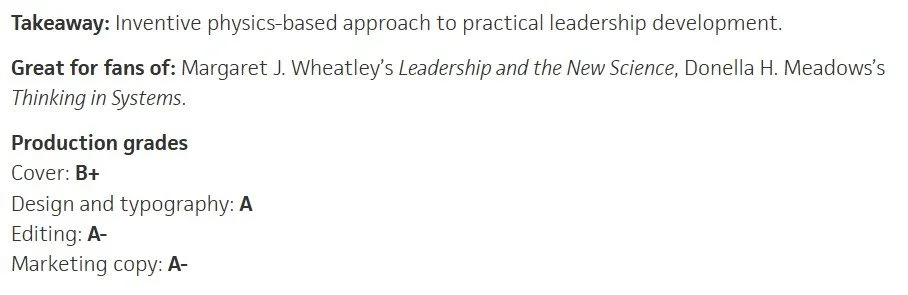
“Leadership behaves less like a toolkit and more like a system,” physician-executive Corvini notes in the first entry in his Leadership Alchemy Series. As the title suggests, The Physics of Leadership frames leadership as a system illuminated through the physical laws governing our universe, with Corvini translating scientific concepts into practical guidance on execution, strategy, culture, energy, uncertainty, stewardship, and more. Corvini touches on many ideas, but the governing principles here are wisdom, intent, and impact. For Corvini, wisdom is not merely possessing information but applying it effectively and ethically, while “impact” refers to having a lasting influence in key areas and “intent” describes “clarity of purpose that directs attention, decisions, and effort toward meaningful outcomes.” The leadership framework here is structured like a physics curriculum, encompassing classical and modern physics, and Corvini offers clear introductions to Newtonian mechanics, thermodynamics, and quantum mechanics, while deriving from each big idea practical takeaways about running a team, not wasting energy, and navigating uncertainty.
Corvini’s clearest analogies liken abstract concepts to everyday management challenges: Newtonian inertia becomes organizational resistance; waves and optics clarify how strategy can be weakened by noise and interpretation; and quantum mechanics serves as a model for decision-making without complete information. The science here is invitingly presented, but Corvini resists oversimplification—this is a book to be read rather than skimmed. His management guidance, like his physics, is serious and convincing, rooted in research and on a firmer intellectual footing than that of many leadership guides. His guidance on “structural constraint mapping” is especially strong, offering welcome insights into handling workplace friction.
Corvini offers ample fresh and on-point exercises and hypothetical leadership scenarios. His personal stories, such as a near-fatal parachute malfunction and navigating a dangerous storm, are relatable. This structured, energetic guide can entice managers who prefer frameworks, diagnostics, and reflection prompts to abstract exhortation, and its unique blend of metaphor and method gives leadership principles a distinctive organizing logic.